The two plants get confused constantly, partly because both are sold under names that describe the flower rather than the plant, and partly because they genuinely are close relatives. Both are Acalypha, both are in the amaranth family, and both are grown for the same thing: the long dangling red tassels that are the female flower spikes.
But they are not interchangeable in a collection, and the difference matters the moment you put one in a pot on a windowsill instead of in a greenhouse border.
Look at the tail, not the leaves
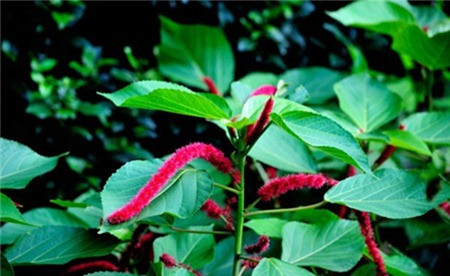
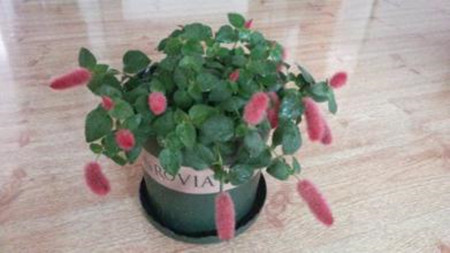
This is the reliable field test. On dog's tail red, the female spikes hang from the leaf axils along the stems and they grow long and thin, often past 20 cm, with a fine bottlebrush texture and a deep red colour. On cat's tail red the spikes are terminal, much shorter, thicker, and a brighter pinkish-red. They look plush rather than feathery, and there are usually far more of them on a far smaller plant.
Hold one at arm's length and the difference is obvious. The confusion only starts when people compare a poor specimen of one against a good specimen of the other.
Leaves and overall size
Dog's tail red is an evergreen shrub. Left to itself it gets tall, and even as a pot plant it is normally kept under about a metre, but the leaves give it away before the flowers do. They are broadly ovate to ovate, up to around 20 cm long, with a wedge-shaped or blunt-rounded base, a pointed tip, and coarse teeth along the margin. The surface is largely hairless apart from a scattering of fine hairs over the midrib and side veins, and the whole leaf is a clear bright green.
Cat's tail red has smaller, narrower ovate leaves with finer teeth, and the plant makes a dense low mound rather than an upright shrub. Because it stays compact and the tails hang, it is the one that works in a hanging basket or a pot on a shelf where you can look up at it.
How long each one actually flowers
Dog's tail red has the longer natural window. In a warm glasshouse or a mild outdoor climate it can carry spikes from February through to November, which is most of the year, and the tassels hold colour for weeks because, like a bougainvillea bract, there is nothing much to wilt. Cat's tail red flowers naturally from spring into autumn, but under indoor cultivation with steady warmth and light it will keep going all year.
Neither of those windows is automatic. Both stop the moment they are cold or dry out hard, and both restart from new growth, which means the plant that has been sitting unwatered on a cold windowsill for six weeks is not resting. It has given up.
What each one wants
The requirements overlap heavily. Both want warmth, both want humidity, and neither is remotely frost-tolerant. In cool climates they are greenhouse or indoor plants, and in northern regions they are winter indoors and summer outside once the nights have warmed.
Where they part company is light and drought. Dog's tail red wants sun and a consistently moist, fertile mix. It is the weaker of the two against dryness; let it go bone dry and it yellows and drops leaves from the bottom up. Cat's tail red is the tougher plant. It copes better with a missed watering, and it is the one that will tolerate a slightly less perfect spot while still throwing tails.
On light, though, the compact one is the more demanding. Cat's tail red wants full brightness and does poorly in low scattered light, where it loses the dense habit and stops producing the short fat spikes that are the whole point of it. Dog's tail red will stretch in shade too, but it at least keeps making leaves.
- Both: warm, humid, free-draining but moisture-retaining mix, never allowed to dry out completely.
- Dog's tail: sun, steady water, more feed, space to grow upward.
- Cat's tail: maximum light, slightly more forgiving of drying, best grown trailing.
Pruning, and why you should do it
Both flower on fresh growth, so both respond to being cut back. Pinch the tips of a young plant to get it branching, because a single stem gives you one tail. Trim hard in spring as new growth starts, and again lightly after a heavy flush fades. Feeding back into the cut with a balanced liquid fertiliser weekly during growth is what keeps the second flush coming.
Old dog's tail red plants go leggy and the lower stems bare. Most people keep them as two or three year specimens and take cuttings from the tips to replace them, which is the honest answer rather than trying to renovate a leggy shrub back into something worth looking at.
One last note on names
If you are buying online and the listing only says "tail red", look at the photo. Long thin crimson tassels on a tall plant with big leaves is dog's tail. Short fat pink ones on a low bushy plant is cat's tail. The plant names in translation vary enough that the picture is worth more than the description.