A round silhouette does not identify a cactus. Examine ribs and spines together, and keep the botanical label rather than relying on a name such as green ball.
The golden barrel
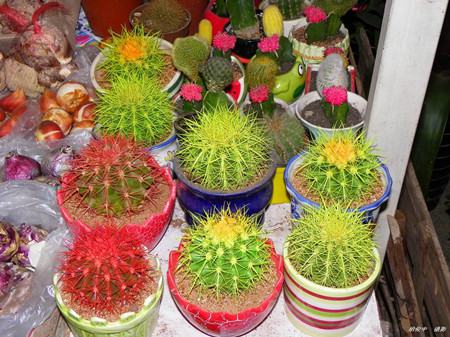
Echinocactus grusonii, the golden barrel, is the ball with the unmistakable look: a globe, sometimes clustered, with a crown at the top covered in dense golden-yellow wool, from which the newest spines emerge. The body has strong ribs running edge to edge.
Its spines are heavy, mostly straight and piercing, yellow when young and browning with age. Count the arrangement: eight to ten radial spines, and around five centrals, thick and slightly bent. That spine load is the practical warning with this plant. It is not a thing to have on a low shelf in a room where children move around, and it is not a plant you can knock a leaf off and fix.
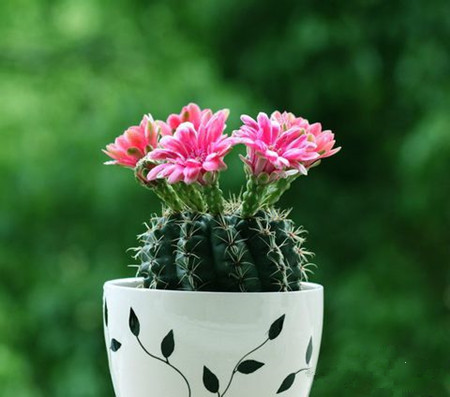
Flowering is where the identification finishes. Golden barrel flowers from the woolly crown between June and October: small, bell-shaped, yellow. A ball that produces a big pale funnel from its side is not this plant, however golden its spines have gone.
In the wild this species is restricted and genuinely rare, a Mexican desert endemic reduced to a handful of populations. Everything in cultivation, worldwide, is propagated. That is worth knowing when someone offers you a wild-collected golden barrel at a good price, which is a sentence that should end the conversation.
The common green ball
What Chinese sellers call 仙人球 in the loose sense, and what English speakers have called the Easter lily cactus or simply a green ball, is a different plant. Spherical to oval, around twenty-five centimetres, green rather than yellow-green body, with longitudinal ribs and spines of uneven length along the edges, pale yellowish-green, with the middle ones longer.
Two features identify it fast. It offsets freely: a mature ball will carry a crowd of small balls at its sides, and any one of those can be twisted off and rooted. And its flowers are large, silvery white or flushed pink, long and funnel-shaped, emerging among the radial spines, with scales on the outside of the tube.
Then there is the flowering habit, which is the most surprising thing about these plants if you have only ever had a golden barrel. The flowers open in the early morning or in the evening and are often finished by the middle of the next day, in summer. A plant that had a flower on it this morning and none tonight is not ill. This is the species, and the reason people never photograph them.
How the difference changes the way you grow them
Both come from desert regions with a hot, dry season, and both want sandy, sharply drained mix and a winter that is dry and cool. Past that they diverge in ways that show up in a house.
The golden barrel grows slowly, stays a single globe for years, and keeps its shape only under strong light. In a dull room it does not die; it deforms, the ribs stretch and the spine spacing widens, and no amount of later correction puts it back. It is a south-window plant or an outdoor summer plant.
The green ball is the more forgiving of the two and the more productive. It tolerates a bit more water in growth, offsets when it is happy, and can be rebuilt from a single side ball if the main one goes soft. If your problem is a plant that has lost its base, the offsetting habit makes it salvageable in a way a single-headed golden barrel is not. The mechanics are the same as any cutting that has to root from a piece of a plant: dry the wound properly, then put it somewhere bright and barely moist.
Neither likes a large pot. Both are more likely to rot from a season of consistent damp than from a season of drought, and the classic way to kill either one is to water on a schedule through winter in a warm room.
If the two are being sold to you as the same thing, the shortest test in the shop is this: run a finger along the spine arrangement, and look for wool at the top. Golden, woolly, single-headed is Echinocactus grusonii. Green, uneven-spined, with baby balls at the base is the everyday one, and it will flower bigger and vanish faster.
Related reading: Growing Cacti in Pots: Light, Mix and Seasonal Care.