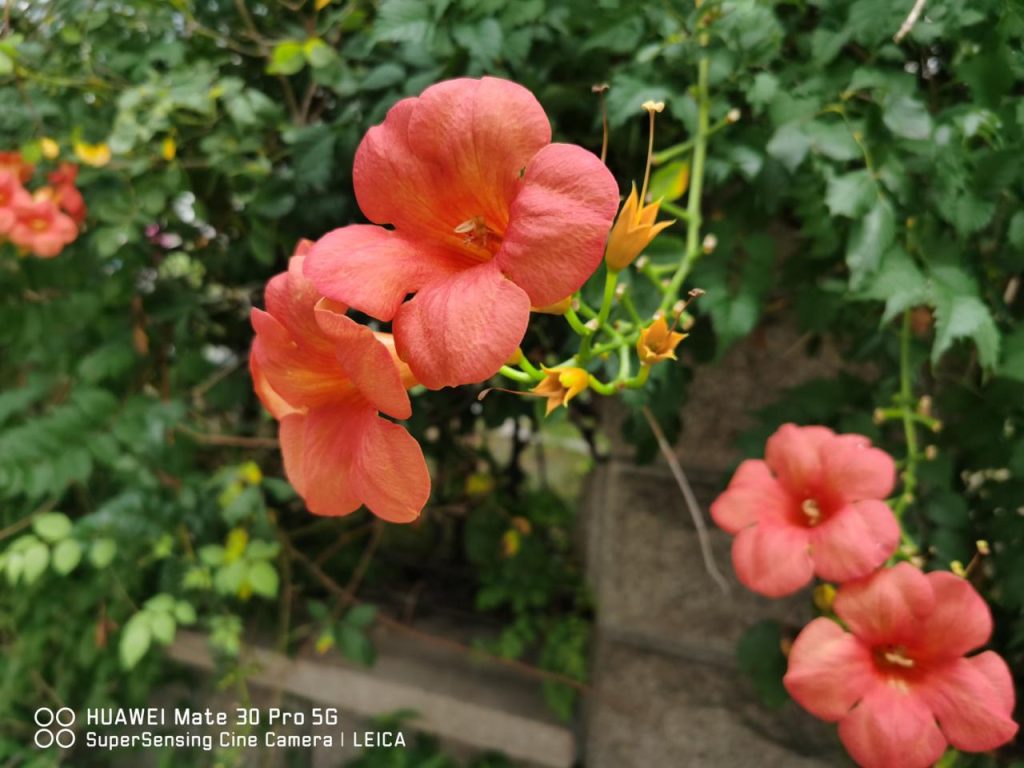
Chinese trumpet vine grows fast, flowers on the wood it makes that spring, and resents being kept cool, dark or pot bound. Everything below follows from those three facts. A plant that is unhappy about its light shows it as thin runs of stem and two or three miserable trusses; the same plant on a south facing balcony with a deep pot is the one people photograph.
Pot, soil and position
Choose depth over width. A deep clay pot or a half barrel beats a wide shallow bowl, because the roots drive down and a plant that cannot do that stops making flowering wood. Fill it with ordinary garden soil mixed with rotted leaf mould, roughly half and half, in a neutral or slightly acid blend. Soil dug from a verge or a roadside bank works if you spread it out and let it bake in the sun for a few days first, then stir in a handful of base fertilizer. Sieved pine needle soil, if you can get it, is the best mix of the lot.
Position is the decision that matters most. Six hours of direct sun is the working minimum, and a south or west balcony with the door open suits it far better than a shaded north aspect where the growth softens and the flower count collapses. Good air movement belongs in the same sentence as light, because a tight, still corner is where aphids start.
Water and the feeding calendar
Keep the mix slightly moist through the growing season, never soggy. The vine tolerates a short dry spell better than a wet saucer, and in winter, when it drops its leaves and rests, the pot should stay on the dry side and no fertilizer goes near it.
It is a greedy plant while it is awake. Base fertilizer goes in at potting. Once spring growth is running, feed every ten to fifteen days with something nitrogen forward to build the branches. From May the aim changes to flowers, so switch to phosphate and keep it up through bud formation. In June, a weak spray of 0.2 per cent monopotassium phosphate on the leaves every seven to ten days pushes the bud set along noticeably. After the first flush fades, one or two more phosphate feeds carry the plant into winter.
Cutting it back, and tying it in
Late winter, while the plant is still asleep, is the pruning window. Take out the dead wood, the thin stuff, anything crossing through the middle, then shorten the long whips back to a strong bud. New vigorous shoots are not cut; they are spread out and tied to the frame, because those are next season’s flower stems. A vine left to knot itself into a tangle flowers at the tips and looks bald underneath.
It needs something to hold onto from the start, so put the rod, trellis or wire in place before the first long shoot has to be moved. Training while the stem is soft and an inch long is a two minute job; the same stem in August needs a saw.
When something goes wrong
Aphids are the regular complaint, and they arrive in the combination the plant hates anyway: high temperature, high humidity, no moving air. Ventilate, and do not let the pot sit in a closed corner through a warm spell. On first sighting, a hard flush of water off the shoots usually keeps a small colony from establishing; handling a sap sucker outbreak covers what to do when flushing is no longer enough.
Flowerless vines almost always trace back to light or to pruning timing. Cut in summer and you remove the wood that was going to bloom. Cut in late winter and shorten the previous year’s runs as above, and the plant responds the way it should. Feeding nitrogen after June does the same damage quietly, growing leaves instead of buds, which is the argument for changing the feed in May rather than topping up the same bottle all summer. The pot itself, drainage holes included, is worth checking against the types of flower pot before you commit to a barrel.