Golden buckwheat and ordinary buckwheat sit in the same genus and look enough alike that people buy one expecting the other. Both are in the dock family, both have arrow-shaped leaves, and both carry clusters of tiny five-lobed flowers that look nothing like the grain most people picture when they hear the word buckwheat.
They are different plants with different uses, though, and once you know the four checks below you can separate them at a glance.
The family giveaway: the brown tube at each node
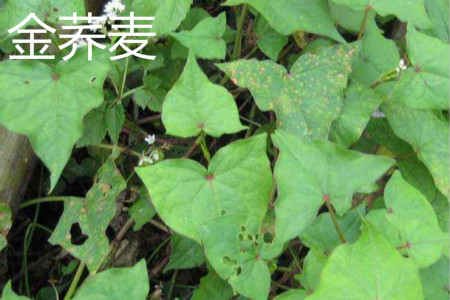
Start here, because it confirms you are looking at the right family before you argue about species. At each node, where the leaf stalk meets the stem, there is a sheath wrapping the stem like a small brown tube. Botanists call it an ochrea, and in these two it is cylindrical and brown. It is the reason both plants belong with docks and knotweeds rather than with anything in the grass family, despite the seed.
Leaves
Golden buckwheat has the larger leaf. Triangular, roughly 4 to 12 cm long and 3 to 11 cm across, with the tip drawn out into a point. The margin is entire, meaning smooth rather than toothed, and the surface carries small nipple-like projections on both sides, which you can feel if you rub a leaf between finger and thumb. The ochrea at the node is sheath-shaped, cylindrical and brown.
Common buckwheat has a similar shape but is clearly smaller: triangular to ovate-triangular, about 2.5 to 7 cm long and 2 to 5 cm wide. On a plant of the same age the difference in leaf size is the quickest field sign.
Flowers and the flower cluster
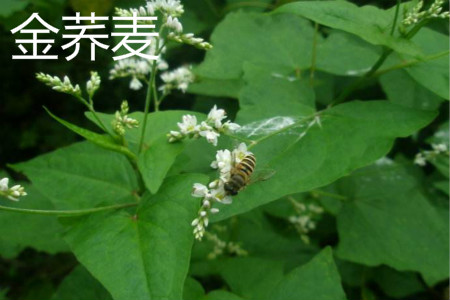
This is where the two are easiest to separate if you look closely, and the difference is in the relationship between the flower stalk and the leaf-like bract at its base.
Golden buckwheat carries a corymbose, umbrella-like cluster. The bracts are oval and lance-shaped, and the flower stalks come out roughly the same length as the bracts, so the cluster sits flat-topped and the flowers are held at a uniform height. The individual flowers have a perianth split into five deep lobes, oval in shape, and the colour is white.
Common buckwheat has an umbel-like or short racemose cluster with oval green bracts, but the flower stalk is noticeably longer than the bract. The flowers are also five-lobed and oval, and the colour ranges from white to pale pinkish-red.
So: stalk shorter or equal to the bract with pure white flowers points to golden buckwheat. Stalk clearly overtopping a green bract, with a pink tinge, points to the annual.
Seed
Both set a three-angled dark brown nut-like seed, and the difference is in proportion.
Golden buckwheat: broadly ovate, dark brown, and noticeably wider for its length.
Common buckwheat: ovate, dark brown, sharper and more pyramid-shaped.
Seed comparison is only useful if you have both in front of you, since the size range overlaps and the colour is the same. The plant habit is a surer guide in the field.
The difference that actually matters: how they live
Common buckwheat is an annual grown as a crop. It germinates, flowers within a couple of months, sets grain, and dies. It is the one that gets sown as a cover crop and milled into flour.
Golden buckwheat is a perennial with a thick dark rhizome underground. It comes back from that rootstock every year, it is considerably tougher in the ground than the annual, and it is the species associated with medicinal use rather than with flour. If you are growing for the grain, the annual is the plant you want. If you are growing something permanent that will hold a slope and come back without being resown, the perennial is the one.
That rhizome is also the practical difficulty. Golden buckwheat spreads from it, and in a border with loose soil it will turn up where it was not put. Give it a bed it can be contained in.
A quick comparison
- Habit: perennial with a thick rhizome, against annual.
- Leaf: 4 to 12 cm, entire margin with nipple-like projections, against 2.5 to 7 cm.
- Flower stalk against bract: about equal, against distinctly longer.
- Flower colour: white, against white or pale red.
- Seed: broadly ovate, against ovate and more sharply angled.
If you have bought seed labelled one and grown something that looks like the other, check the base of the plant in its second year. A thick woody rootstock that survives the winter settles the argument faster than any measurement of leaf size.
If you are identifying a plant rather than choosing one to grow, the same discipline of checking the node and the reproductive parts instead of the general impression is what separates the two tail reds. The vocabulary for the rest of it is in what a cutting is.