Two of the scented shrubs sold in Chinese gardens are hanxiao, Michelia figo, and bailan, Michelia alba. Neither name survives translation intact, which is why the same two plants turn up in English catalogues as banana shrub, port wine magnolia, mock orchid and white orchid tree, sometimes attached to the wrong plant. The botanical names are the safe ground, and they also explain the confusion: both belong to the magnolia family, and both have been moved into Magnolia by recent classification, so you will see Magnolia figo, as well as Magnolia × alba, on labels.
Leaves
Hanxiao leaves are leathery, in narrow oval to obovate-oval shapes, roughly 4 to 10 cm long and about 1.8 to 4 cm wide. The tip is blunt with a short point, the base wedge-shaped, and the upper surface carries a distinct gloss. The detail that settles arguments is the petiole: 2 to 4 mm. That is a stub.
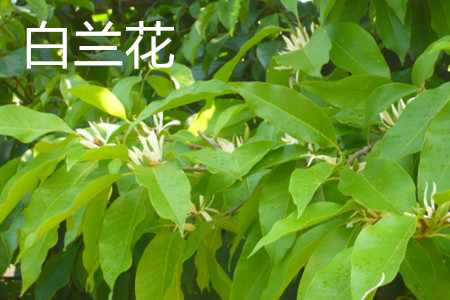
Bailan leaves are visibly thinner in substance, much larger, long oval to broadly oval, around 10 to 27 cm long and 4 to 9.5 cm wide, wedge-based and hairless above. Their petiole runs 1.5 to 2 cm, which is several times the length on the other plant. Put a leaf of each on a table and the size gap is obvious before you reach for a rule.
Flowers
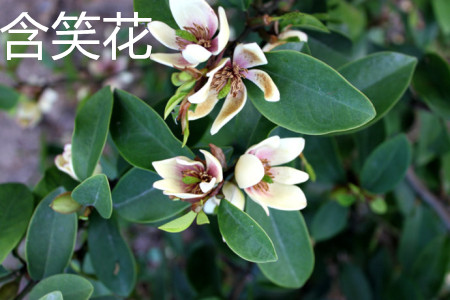
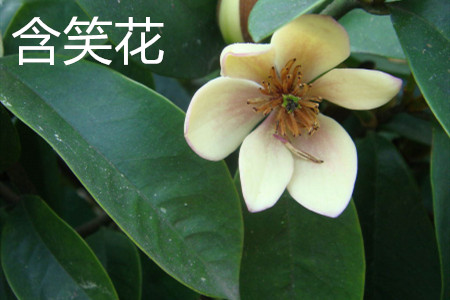
Hanxiao flowers on short stalks, pale yellow, often shading to red or purple at the edges, about 12 to 20 mm long and 6 to 11 mm across, with oblong petals that never flatten out fully. That half-open habit is where the name comes from: the flower looks as though it is about to open and then holds back, which is a much better identification feature than colour, since colour shifts with age and light.
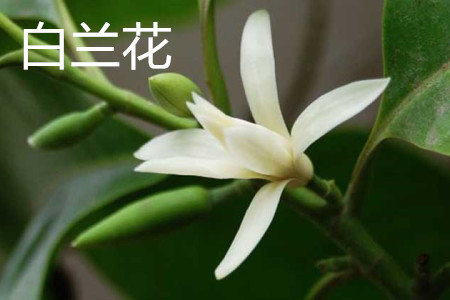
Bailan flowers are white, longer and slimmer, and the scent is stronger and more citrus-like than the mild apple note a hanxiao flower gives off. Flowering runs from April through September, so a scented white sprig in high summer is bailan, and small cream-and-mauve flowers in spring on a compact shrub are hanxiao.
Habit, and what each one wants
Hanxiao is the slow, tight, easily-potted plant: a dense evergreen shrub that takes clipping, stays small for years and is comfortable on a balcony or in a container. Bailan grows on into something closer to a small tree, needs the room it gets in the ground, and is the one you meet as a street tree and a temple tree in warm southern districts rather than as a patio pot.
Both want the same basic thing: acid, humus-rich soil that drains, moisture without sitting wet, and shelter from hard frost while young. Both are grown for the scent rather than the foliage, so thin light costs you flowers before it costs you leaves, and a plant that is stretched and leafy but never blooming is almost always a light problem rather than a feeding one. Feeding a scented michelia the way you would feed a foliage plant produces exactly that: leaves, and no perfume. If you are mixing your own, read what pine needle compost really is before you assume acidity is the thing to fix.