Money tree, pachira, is sold as a thick-stemned pot plant with a braided trunk and it arrives with two reputations: easy, and prone to suddenly dropping every leaf. Both are correct, and the second one has a single common cause.
Roots, pot and mix
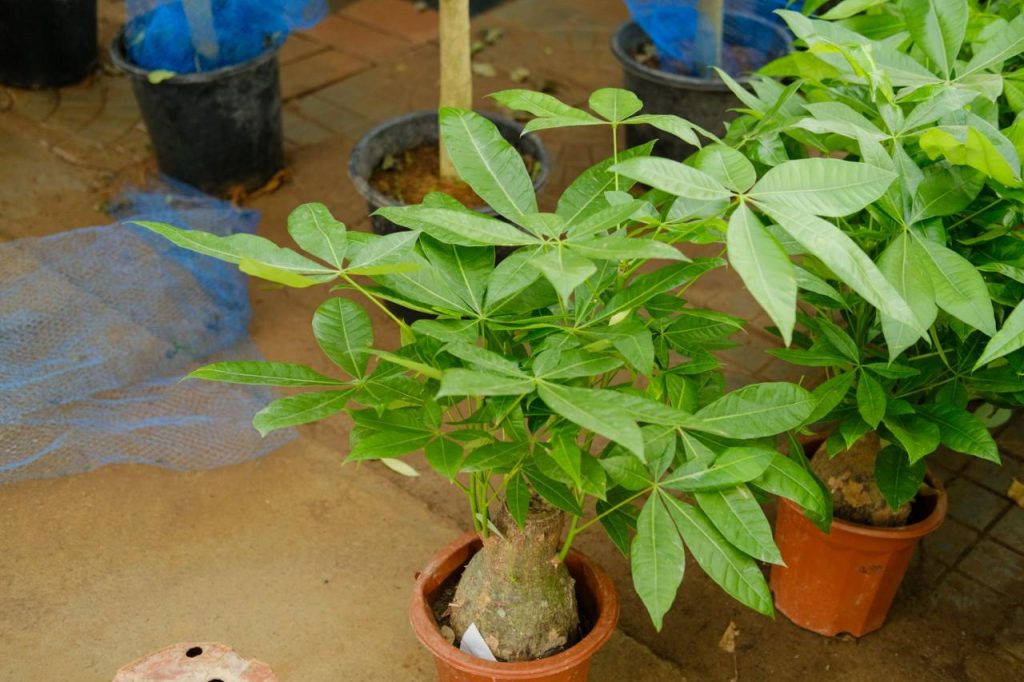
The root system is shallow and not particularly developed for the size of the top, which is the fact everything else follows from. A large deep pot holds a volume of wet medium the roots cannot possibly use, and the surplus stays wet around the base of the trunk until the roots rot. Choose a pot that suits the root ball rather than the furniture, and make sure it breathes and drains. Terracotta is not a stylistic compromise here, it is the functional answer.
The mix should be loose and open: a base of loam or peat with leaf mould and coarse sand, and a small amount of slow fertiliser or poultry manure worked in as a base feed. Rich clay-based soil in a deep pot is the combination the plant cannot handle.
Watering, the part with a rule of thumb
Too little water gives slow growth and a thin crown. Too much gives root rot and a dead plant, and it is far more common. The working principle is to water generously during active growth and to hold back otherwise: large established plants in summer want more, a newly potted small plant in a cool room wants much less. Whatever the season, the pot must drain freely and must not sit in the water that comes out of it.
Light, temperature and humidity
Pachira wants warmth and light. The growth band is roughly 20 to 30 °C, and it is a hot-country plant from tropical America, so a cold room stops it. Below about 10 °C it suffers; leaf drop follows, and a sustained drop to the 5 to 6 °C range can finish it, which is why the winter position matters more than the summer one. In frost-free districts it will carry on outdoors; in cold ones it comes inside.
Give it the brightest ordinary light in the house rather than harsh midday sun through glass, which scorches the leaflets. Keep the plant oriented the same way to the light and turn the pot every few days, because the foliage grows toward one direction and an unturned plant ends up lopsided. Misting the leaves every three or four days raises the humidity around it, which helps the plant look better and keep its leaves through a dry heated winter.
Feeding and pruning
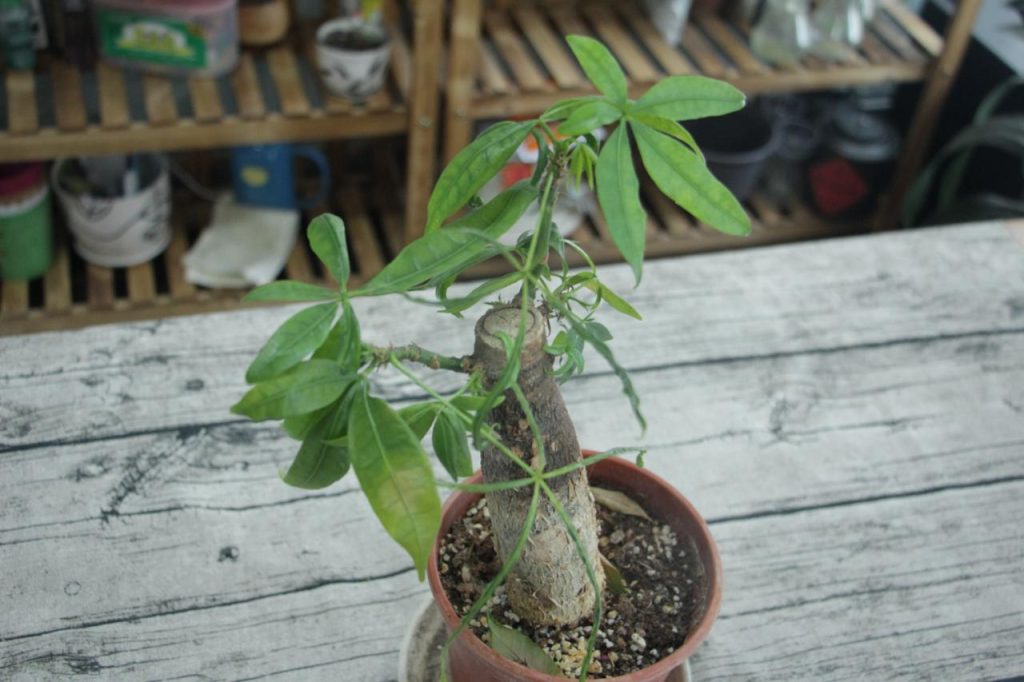
Pachira is a leaf plant and it grows enough to need feeding, more than most houseplants: during the May to September growth run, a feed about every fortnight. Repotting follows roughly the same rhythm, and the plant is trimmed at repotting to push fresh growth rather than being left to run up as a single leggy stem.
Pruning is what keeps a pot plant worth looking at. In the ground the tree needs nothing; in a pot it grows fast enough to spoil its own shape, and cutting it back controls both the rate and the form. Take out crossing and weak wood and shorten long shoots back to a bud facing the way you want the branch to go.
Making more of them
Two methods: seed and cuttings. Sow while it is warm, around 20 °C and above. Take cuttings in May or June from a healthy stem, in the same conditions a softwood cutting needs anywhere else, and keep them humid until they strike.
Watch for root rot and leaf spot, and for boring larvae in the stems, which is the pest that takes a mature trunk from the inside. Yellow leaves are the general alarm, and before treating them as a feeding problem it is worth reading the pattern properly in which nutrient the plant is short of. Pot size and mix for a plant that resents both are handled in pot choice and the repotting rule, and if you are reusing your own soil for the repot, disinfecting it first is the cheap precaution.