Tree philodendron and monstera are the two big split-leaved foliage plants in Chinese halls and living rooms, and they are routinely sold as one another. They are not the same plant and they do not want the same treatment: one grows into a self-supporting plant with a short trunk, the other is a climber that will spend its life reaching for something.
Leaves
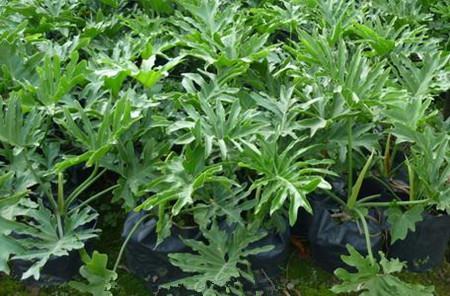
Tree philodendron leaves are enormous, deeply pinnately cut from the midrib toward the margin rather than holed, dark green, thick, and glossy, on very stout petioles. The plant holds them out from a compact central crown, so the whole plant reads as a symmetrical, tidy, upright clump even at size.
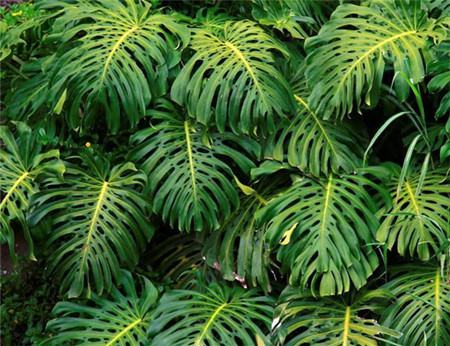
Monstera leaves are also large, thick, glossy and heart-based, but the marking is different: the classic half-moon splits open from the margin and, on mature growth, there are oval holes set in the blade between the veins. The petiole is long, flattish on top, rough-edged and broad-based. That combination, cut plus hole plus a flattopped stalk, is what the Chinese name for it refers to.
Stem, and the one test that settles it
Here is the distinction nobody uses. A tree philodendron has a short, stocky, upright stem carrying the leaves in neat rings; it is a rosette-ish plant that gets wider rather than taller, and it does not climb. A monstera is a climbing shrub, and it behaves like one: aerial roots from every node, a thin stem that leans, and a need for a moss pole, a wall, a tree or a stake. A mature monstera on a support grows to a size no indoor pot should be allowed to reach; a mature tree philodendron stays a symmetrical mound.
So if the plant is putting out straggly roots along the stalk and reaching sideways, that is a monstera, and it is asking for support rather than complaining.
Where each one comes from and what follows
The tree philodendron is a subtropical evergreen of warm, humid, forest-floor conditions: it wants heat, moisture and a fertile, loose, freely draining mix, and its one tolerance is light. It does not need strong sun and does badly in a corner with nothing, so the practical advice is bright shade, never deep shade. Monstera is likewise a warm, humid, weak-light plant that resents strong sun and dry air, and in the parts of Fujian and Guangdong where the winter is mild it grows outdoors without protection; further north it is a greenhouse or house plant that must be kept warm, or growth simply stops.
Both are kept for foliage, and the usual air-purifying claims made for them rest on the same thing that makes any large-leaved plant useful in a room: leaf area, and the moisture it holds. Neither is a good choice where a child or a cat will chew it, since the sap of both is full of needle-shaped crystals that irritate the mouth and skin.
Which to buy
Buy the tree philodendron if you want a stately, stationary plant for a floor by a bright window, something that holds its shape and does not need a support. Buy the monstera if you have a light position with something to train it up, and you want the cut-and-hole leaf that only shows properly on climbing, mature growth. Propagating the second of those is dealt with in how to propagate monstera from a cutting, including a frank note about success rates. The watering question that trips up both plants sits in watering tree philodendron.