Striped, firm-leaved haworthiopsis and softer window-leaved haworthias are often grouped together in shops. Their appearance and labels deserve checking before you assume they share identical care.
Reading the leaf
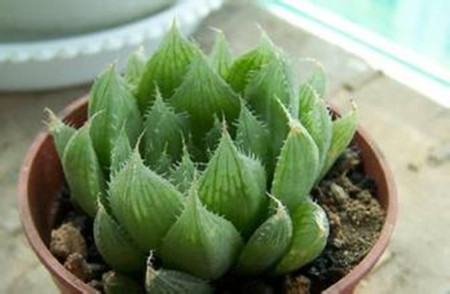
The striped type is a short, tight plant with thick fleshy leaves carried on a stubby stem, arranged in a dense rosette. The leaf surface is emerald green and only partly translucent, marked with a band of dark stripes down the face, sometimes with brownish or bluish patches in the middle, and the margins are pink-tinged and finely toothed. Run a finger across it and it feels uneven. The flower spike rises from the centre and carries a tight cluster of very small blooms.
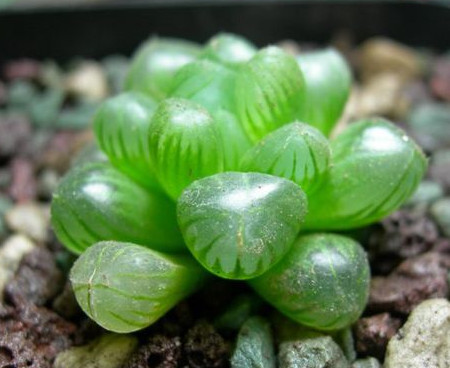
The jade lotus is smaller and the difference is immediate. Its leaves are rounded, fat and clear, like drops of water, and the transparency varies with the season from almost see-through to a thicker, cloudier green. Fine green lines run through the leaf, the tips are smooth rather than armed, and the whole rosette sits packed and upright. Its flower stem carries a looser spike of small white flowers.
What the structure means for care
Striped types are the tougher of the two. They handle warmth, they tolerate drought, and they want a bright position with some direct light. The working temperature is 20 to 25 °C, and it is the cold that finishes them rather than anything else. They dislike heat and wet in equal measure, so the summer routine is shade, air and less water.
The window-leaved plant is the more particular one, and the reason is those translucent leaves. It grows best in cool, semi-shaded conditions, with spring and autumn as the strong seasons. Hot humid weather combined with direct light is what cooks it, and the opposite error, a dark corner with no light at all, stretches the rosette and clouds the leaf. It wants bright shade, which is a narrower position to find than it sounds.
Both are small pots and small appetites, and both are propagated from offsets rather than from seed, with autumn the reliable season for it, as argued at propagating succulents in autumn. The same problem of two similar-looking plants that want different things comes up with golden barrel and the common green ball, and the striped type is often confused with the two acalyphas by people buying on the leaf pattern alone.
Related reading: Haworthia Truncata Care: Light, Roots and Moisture.