Coleus and perilla are the two plants in this family that get sold for completely opposite purposes, one to be looked at and one to be eaten, and they are confused with each other constantly because they share the whole family toolkit: square stems, leaves set in opposite pairs, toothed leaf margins, a hairy covering on both surfaces. If you only look at the leaf shape you will not separate them. Four other things do it.
Leaf colour and substance
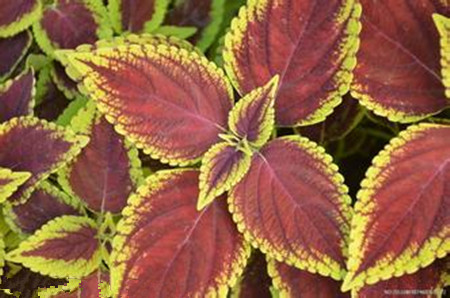
Coleus is the one with the colour. A single plant carries green, yellow, pink, red, chocolate and near-black in the same leaf, and the pattern is what the plant is bought for. The blade is ovate with a long-pointed tip and blunt teeth along the edge, soft, thin, and carried on a stem that is densely hairy and four-angled, tending to bare out at the base as it ages.
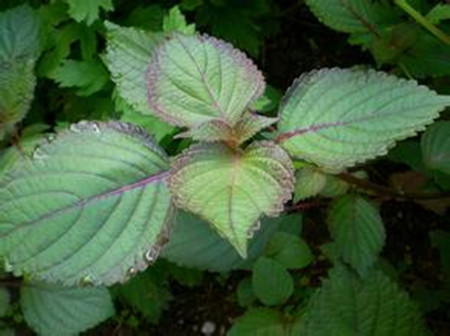
Perilla leaves run to two colours only, green or purple, usually the same colour top and bottom or with the underside darker. The blade is broadly ovate to round, the tip short-pointed or abrupt, the base rounded to broadly wedge-shaped, and both surfaces carry sparse hairs. It tastes of the thing you put it on with, which is a fairly decisive test when the visual ones are inconclusive.
Flowers
Coleus produces an all-round terminal spike of small flowers in the pale blue to pale purple range. It flowers reliably, and the flower spike is the reason house growers lose the plant's looks: the plant puts its effort into seed, the lower stems bare out and the leaf colour dulls.
Perilla's flowers sit in whorls around the stem rather than in one continuous terminal spike, and they are noticeably larger and mostly pinkish-white. It is also an annual, which is the third difference: it germinates, grows, flowers and sets seed inside one season, while coleus is a perennial that must be carried through the winter to survive it.
Hardiness, and what that decides
Coleus wants warmth and will not take cold. Below about 10 °C it stops, drops leaves and often dies, which is why it behaves as an annual in cold districts and as a year-round pot plant in the south. Strong summer sun bleaches it; bright light with some afternoon shade keeps the colour at its clearest, so the plant is asking for a specific position rather than any sunny one.
Perilla is the tougher of the two by a wide margin. It grows in ordinary sandy soil with good drainage, colonises the ground in front of a house, the edge of a field and the strip under fruit trees, and copes with frost by simply completing its cycle the following year from fallen seed. If you have a spare patch and want leaves to use, it is the one to sow. If you want a pot that looks designed, it is not.
For a third plant caught in the same confusion, the comparison between dog's tail and cat's tail acalypha makes the point from the other direction: two species in one genus, sold as one another, separated by the flower rather than the leaf.