June sits in the middle of the cutting calendar for woody plants. Spring growth has thickened at the base but is not yet fully bark-covered, the plant is still making new cells, and the weather is warm enough to keep a tray from going cold. Cuttings are usually grouped into hard and easy, and the grouping is worth knowing before you spend an afternoon on something that will not root.
The ones that take easily
Rose, crape myrtle, pomegranate, hibiscus, winter jasmine and the small-leaved shrubs sold as boundary plants all root readily from June cuttings. So do most of the herbaceous things you can pinch off a kitchen window sill.
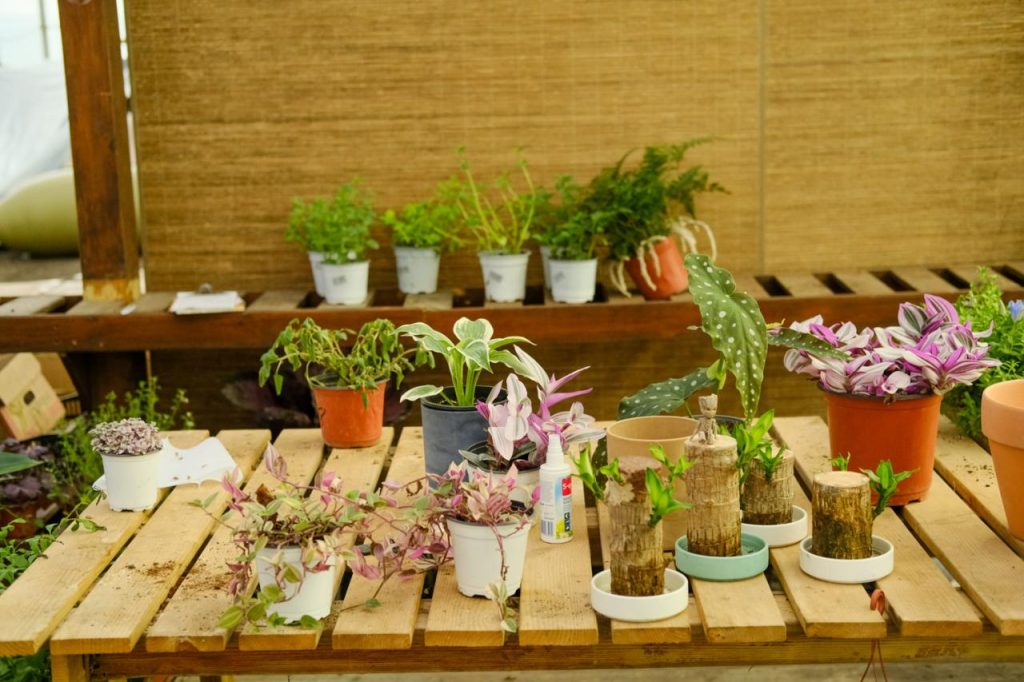
The soft and herbaceous list is longer than people expect: pothos, geranium, coleus, viola and marigold can all be struck in June, and they will do it in a glass of water on a windowsill. Herbaceous cuttings have no bark to slow them down, so they need less ceremony than anything else. Take a piece with two or three nodes, remove the lower leaves, and put it somewhere bright and humid.
The ones that argue back
Camellia, osmanthus, lilac and the waxier-leaved evergreens are the stubborn group. They are not impossible, but they root slowly, they root unevenly, and they will not tolerate the shortcuts the easy group forgives. Expect to lose a third of a batch even when everything is done right, which is the main reason to take more cuttings than you need rather than exactly the number you want.
For these plants, June is the right month precisely because the wood is semi-ripe. Fully soft new growth in May collapses; fully hardened growth in August is late and slow. The stage in between, where the stem snaps cleanly rather than bending, is what camellia wants.
The method, using camellia as the worked example
Choose a shoot that has gone semi-woody: firm at the base, still green enough to bend a little before it breaks. Cut about eight to ten centimetres below a node, at an angle, and strip the leaves from the bottom third. Leave two or three at the top. If the remaining leaves are large, cut each one in half across the midrib. Losing water through leaves is what kills a cutting before it has roots, and half a leaf feeds the shoot while losing half as much.
The medium should drain fast and hold moisture: washed river sand, or sand cut with a little fine grit. Fill the pot, water it first so the sand settles, then make the hole with a pencil rather than pushing the stem in. A cutting shoved straight into dry sand has its cut end scraped and often shredded, and you have taken away the clean surface the roots were going to start from.
Insert to about half the length of the cutting. Firm the sand around it, water again, and then cover. Put a small frame, a hoop or an inverted pot over the tray first, and put the plastic over that rather than directly onto the leaves. Contact between film and foliage means wet spots, and wet spots mean grey mould.
Double-layer film is what the old guides recommend, with the outer layer shaded. The logic is light control: the cuttings need bright, not sun. Set the tray where it gets several hours of bright shade and never direct afternoon sun in June.
Temperature, water and the wait
Keep it under thirty degrees. Above that, a sealed propagator cooks its own contents, and the leaves blacken inside a humid tent that was supposed to be protecting them. If the tray is in full sun, the temperature inside the film is far above the temperature you read on the outdoor thermometer. That is where the shade and the double layer come from.
Open the cover every few days to let the surface air, and close it again quickly. Condensation dripping off film onto a leaf is not the free humidity people think it is. It is a route to leaf spot.
Rooting takes roughly a month for camellia, sometimes longer, sometimes a bit less. Do not lift them to look. A cutting that resists a very gentle tug has something holding it; one that lifts freely has not rooted yet, or has broken what it had. Test one, not all.
What to do with rooted cuttings
Move them into light for a week or two before potting on, so they are not transferred straight from a saturated tent into open air. That shock curls and drops the leaves that kept the plant alive, and a bare stick can sit for a month before anyone works out it is dead.
Pot into ordinary compost, keep the mix barely moist, and do not feed for several weeks. There are no roots worth feeding yet. The same discipline applies to every cutting-raised plant, whether it is a camellia or a houseplant.
If you are trying to decide whether a particular plant is worth the trouble at all, note this: some of the slower things, camellia especially, are often easier layered onto a rootstock than struck from a loose cutting. Air layering keeps the future plant attached to a parent that is watering and feeding it, so a slow rooter has time. June is also a good month for that, and the loss rate is much lower.
Pingback: Hibiscus syriacus Cuttings: Timing and Method
Comments are closed.